
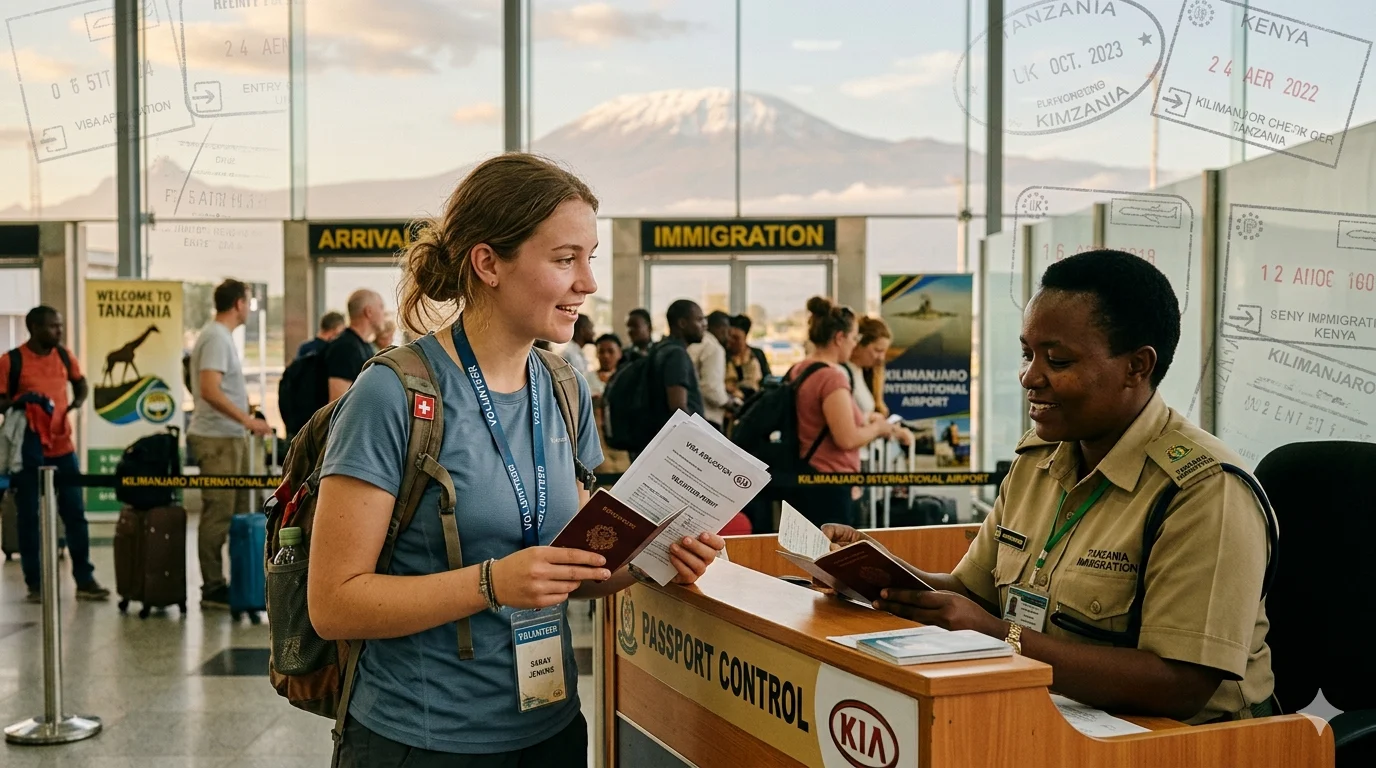
So, you’ve decided you want to volunteer in Tanzania, brilliant choice! You’ve probably already pictured yourself teaching in a Moshi classroom, supporting a medical centre near Kilimanjaro, or working alongside a women’s cooperative in the community. But before you start packing, one question has likely crossed your mind: Can I just use my tourist visa?
It’s one of the most common questions we receive at Hostel Hoff, and the answer matters enormously, both for your safety and your legal standing in Tanzania. Let’s break it down clearly.
Visitor Visas and Volunteer Work in Tanzania
A standard visitor (tourist) visa does not legally permit you to carry out volunteer work in Tanzania. This is a firm distinction under Tanzanian immigration law, and every prospective volunteer must understand it before travelling.
A tourist visa is issued specifically for leisure, sightseeing, and short-term recreation. It does not grant permission to engage in any organised activity, paid or unpaid, on behalf of a local organisation or NGO. Volunteer work, even when unpaid and charitable, is considered a structured activity under Tanzanian immigration regulations and falls outside the permitted scope of a visitor visa.
Entering Tanzania on a tourist visa and then proceeding to volunteer constitutes a breach of your visa conditions. The consequences can include deportation, fines, and being barred from re-entry. More importantly, it places the local organisation hosting you at risk. If you’re planning to volunteer, you need the right documentation from the outset.
What Visa Do You Need to Volunteer in Tanzania?
Now that you know you cannot use your visitor visa for volunteering, let us know what visa is required to volunteer in Tanzania:
Understanding the Class C Residence Permit
For volunteers planning a stay of more than 90 days, the correct legal instrument is the Class C Residence Permit, issued by the Tanzania Immigration Department. This permit is specifically designed for foreigners who do not qualify for Class A (investor) or Class B (employed expatriate) permits. It explicitly covers volunteers, missionaries, researchers, interns, and medical patients, among others.
According to the official Tanzania Immigration Department, applications for the Class C Residence Permit must be submitted before the applicant enters Tanzania. You cannot apply for it after arrival in the country on a tourist visa. This makes planning essential.
For most volunteers heading to Tanzania for a placement of one to three months, however, there is a more accessible and practical route, a specific category of entry visa designed for short-term volunteers. This is what the majority of Hostel Hoff’s volunteers use, and it is covered in detail in the next section.
Volunteer Visa Requirements for Short-Term Stays (1–3 Months)
For placements lasting up to three months, Hostel Hoff confirms that volunteers require an Ordinary Visa (A6), which is the standard volunteer visa for this duration. This is separate from a tourist visa as it is issued with the specific purpose of volunteering and is a mandatory requirement for anyone volunteering in Tanzania, as implemented by the Tanzanian government.
The visa costs USD $50 for most nationalities, and USD $100 for American passport holders. It can be purchased upon arrival at major entry points, including Kilimanjaro International Airport, or applied for online in advance via the Tanzania Immigration eServices portal, though note that the online process can take two to three weeks to complete.
Three visa categories cover volunteers and students on placements:
- Ordinary Visa A6: for general volunteers
- Student Visa C2: for volunteer students
- Student Visa C1: for interns
All three are non-renewable and valid for up to three months.
Important: These are not tourist visas. When you arrive at the border or airport, you must declare that you are entering as a volunteer and present the supporting documentation from your host organisation.
What Documents Do You Need at the Border?
This is where being booked and prepared in advance genuinely counts. To finalise your volunteer visa at the point of entry into Tanzania, you will need to present:
- An official invitation letter from your host organisation (Hostel Hoff sends this to you once your booking is confirmed)
- Your visa fee, which is USD $50 (or USD $100 for US passport holders)
- A copy of the organisation’s registration certificate (again, Hostel Hoff emails this to you after booking)
This documentation package is what differentiates a volunteer entrant from a tourist. Without it, border officials may issue you a standard tourist visa, which would prevent you from legally volunteering. Hostel Hoff handles the paperwork on their end, so as long as you have finalised your booking before you fly, you will receive everything you need.
One practical note: if you are bringing USD in cash to pay your visa fee, ensure all notes are printed on or after 2009. Older-print USD notes are not accepted anywhere in Tanzania.
What About Volunteering for Longer Than Three Months?
If your placement extends beyond three months, you move into Class C Residence Permit territory. As outlined by the Tanzania Embassy in Washington, D.C., applications for Class C permits must be submitted outside Tanzania and are forwarded directly to the Director of Immigration Services. General requirements include:
- A valid passport with at least six months’ remaining validity
- An exemption letter from the relevant authority (for volunteers and NGO workers)
- A volunteer contract detailing your role and activities
- Evidence of your host organisation’s registration with relevant government bodies
- A covering letter from the applicant
For longer placements, Hostel Hoff recommends contacting them directly at info@hostelhoff.com to discuss the additional requirements. Each case may differ based on the nature of the placement and the professional background (for example, medical internships have specific documentation requirements).
How Hostel Hoff Supports You Through the Process
Visa logistics can feel daunting, especially if this is your first time travelling beyond a standard holiday. That is precisely where Hostel Hoff, based in Moshi at the foot of Mount Kilimanjaro, makes the process far more manageable.
Operating since 2006, Hostel Hoff is a small, family-run volunteer accommodation provider that works with around 20 local projects across Moshi. Their model is built on a simple principle: you should not have to pay to volunteer. You cover your accommodation, which includes a bed, breakfast, dinner, and laundry, and Hostel Hoff organises your volunteer placement free of charge.
Once you book your place, the team sends you the invitation letter and organisation registration certificate you need to obtain your volunteer visa at the border. They also guide you on which visa category applies to your situation, connect you with a suitable project, and help you navigate your first day at your placement.
Projects span a wide range of meaningful work: nursery and primary schools, centres for children with disabilities, women’s groups, medical centres, community development initiatives, and conservation programmes. For those with professional backgrounds, internship placements are also available in medicine, nursing, occupational therapy, and teaching.
If you are in the early stages of planning and want to connect with people who have been through the process themselves, Hostel Hoff’s community of past volunteers is active on their Facebook page, Hostel Hoffers, a genuine resource for first-hand insight.