What to do during a volunteering opportunity in Tanzania? I don’t know anything there; what will I even learn from there?
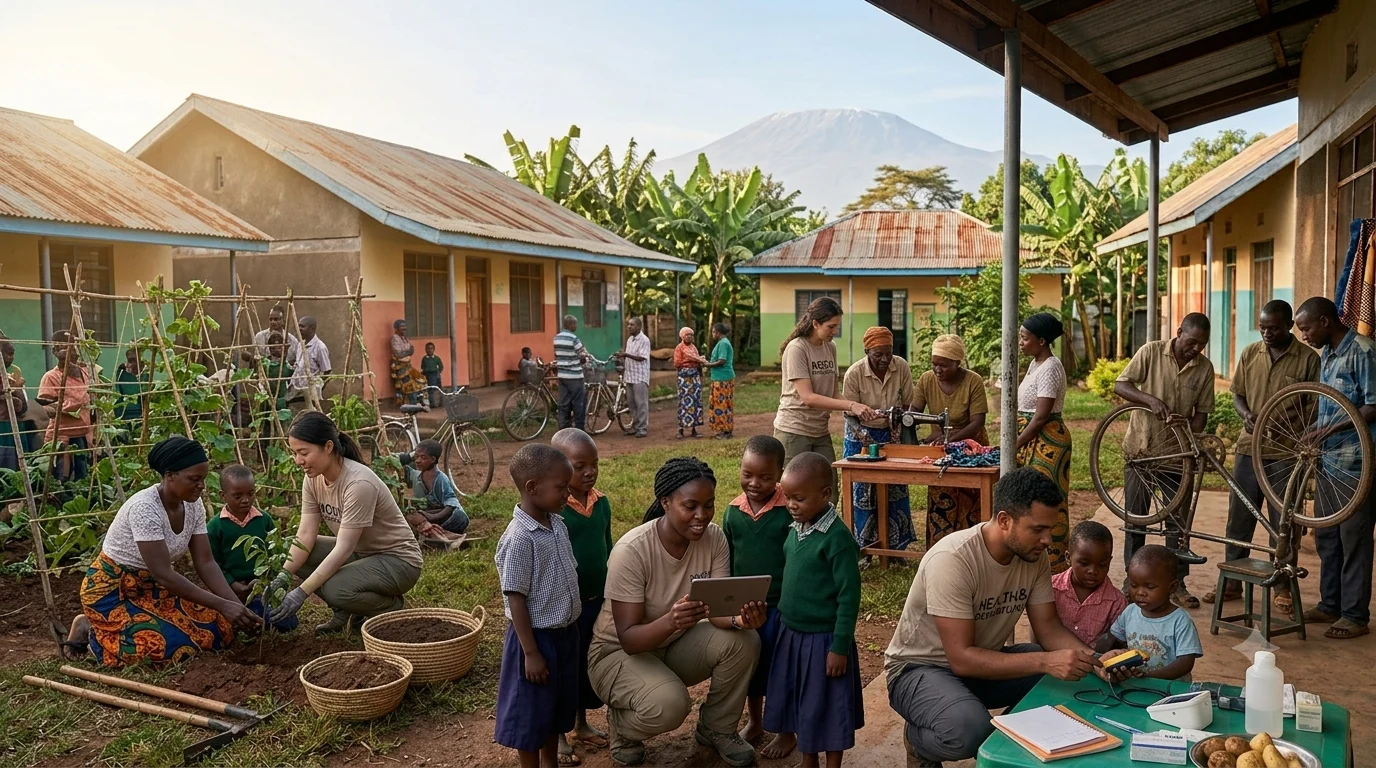
The answer depends on what sector you are working in! Tanzania has a lot of opportunities when it comes to volunteering. Help is required in every sector there, and as a volunteer you will have a lot of options to choose from.
You need to analyse the best suited one for your profile with the skills you have. A volunteer working in a school will have a different work-life from a volunteer working in a hospital clinic. So, it is up to you what to choose!
This blog brings to you all the volunteering opportunities you will have when you come to Tanzania.
Education Volunteering and Teaching Support
Teaching is our largest category, and there is a clear reason for that. Tanzanian primary schools teach in Swahili while secondary schools switch to English. That transition is difficult for children, so extra help with English language skills makes a measurable difference.
As a teaching volunteer, you might take small groups out of a class of sixty, run individual tuition for children falling behind, or lead activities in drama, music, gardening, hygiene and human rights. You do not need a teaching qualification. Plenty of our volunteers work as classroom assistants or activity leaders and are enormously valuable in that role.
Skills you build: public speaking, lesson planning, patience, classroom management, adapting explanations for different abilities, and creative problem solving.
If education volunteering appeals to you, look at our teaching internships in Tanzania and our blog on education and teaching opportunities.
Childcare and Orphanage Work
There are many orphanages in and around Moshi, largely because of the effects of HIV and AIDS and of poverty. Path to Africa, our own charity, financially supports Hope Village Orphanage, which functions more like a family home. A few children live there under the care of one local woman.
Volunteers usually arrive after the children return from school, helping with homework and running games and activities. During school hours, there is often practical work to do, including farming and household tasks. No formal skills are needed here. A real affection for children is the only requirement.
Skills you build: emotional resilience, communication with children, informal mentoring, reliability and the ability to keep your energy up when a day has been long.
Healthcare Volunteering and Hospital Volunteering
We work with a number of small clinics and hospitals that need support from people with a medical background, including medical students, doctors, nurses, midwives and laboratory technologists. Healthcare volunteering here means assisting local health workers rather than replacing them.
Depending on your qualifications, you could help with patient education, basic health screenings, hygiene workshops, or outreach on malaria, maternal health, and HIV. Volunteers consistently describe the exposure as far broader than anything they would see at home in the same period.
Hospital volunteering is one of the strongest ways to test an interest in a healthcare career and that it reliably builds confidence. That matches what we hear from our own volunteers.
Skills you build: clinical observation, working calmly under pressure, communicating across a language barrier, cultural sensitivity in patient care, and a realistic understanding of medicine in a setting with limited resources.
Start with our medical and nursing internships and our guide to medical volunteering in Tanzania.
Supporting Children and Young People With Disabilities
This is one of the most needed and least understood areas of our work. According to Tanzania’s national disability survey of 2008, around 3.2 million Tanzanians aged seven and above live with some form of disability. Many are excluded from public life and stay hidden at home because of stigma.
We currently work with eleven centres in the Moshi area. Some focus on physical disabilities and others on conditions such as autism and Down syndrome.
Volunteers play with the children, help with drawing and writing, assist at mealtimes and support simple exercises. Occupational therapists, physiotherapists and anyone with special educational needs experience are especially useful, and can train the local caregivers directly.
Skills you build: patience, observation, adapting activities to individual needs, and knowledge transfer if you have professional training to share.
Community Development and Women’s Projects
Many women’s groups around Moshi are led by women who are widowed, HIV positive or caring for relatives’ children. They run microfinance schemes, education projects and health awareness campaigns.
Volunteers help with microfinance administration, teaching, record keeping and fundraising. Because these relationships take time to build, we ask volunteers interested in community development to commit to a minimum of three months.
Skills you build: project management, budgeting, stakeholder communication, cultural awareness and the discipline of working towards outcomes you will not personally see finished.
See our community development internships for more.
Manual, Environmental and Skills-Based Work
Construction, farming and tree planting come up regularly across our projects. One orphanage runs a farm that feeds the children. Other projects plant trees in villages affected by deforestation.
Separately, we have connections with projects that need lawyers, web designers, software developers, social workers and therapists. This is skill-based volunteering, where a professional applies existing expertise to a cause that could not otherwise afford it. If you have a specialism, please tell us, and we will look for a match.
Skills you build: practical trade skills, teamwork, physical stamina, and for professionals, the experience of applying your expertise somewhere with very different constraints.
Wildlife, Conservation and Animal Welfare
Awareness of environmental sustainability is growing across the Kilimanjaro region, and several of our partner projects have developed environmental strands to their work. Volunteers help raise awareness of conservation, climate and wildlife protection among local people, and support the practical side by growing and planting trees where deforestation has taken its toll. You rarely need specialist knowledge to begin; you need a willingness to learn.
Skills you build: environmental literacy, community outreach, campaign planning and the ability to explain complicated ideas in simple language.
What All of These Have in Common?
Whatever category you land in, certain things carry across. You will learn to communicate when words fail you. You will get comfortable with plans changing at very short notice. You will practise asking questions before offering solutions, a habit that serves people well long after they leave Tanzania. Most volunteers also pick up conversational Swahili along the way, and we explain why that matters in our blog on learning Swahili while volunteering.
Note that none of this shows up neatly on a certificate. It shows up in how you work.
Choosing Between the Different Types of Volunteer Work
Ask yourself three honest questions.
What are you good at?
How long can you stay?
What do you want to be different about you afterwards?
Short placements suit teaching and childcare. Longer stays suit community development and healthcare, where trust takes time. Our blog on how to choose the right volunteer program walks through this properly, and the volunteering guide covers the practical side.
Whatever you pick, browse the full range of volunteer opportunities in Tanzania first, then contact us. Book early, and you will have more projects to choose from.